Pablo Picasso (1881-1973)
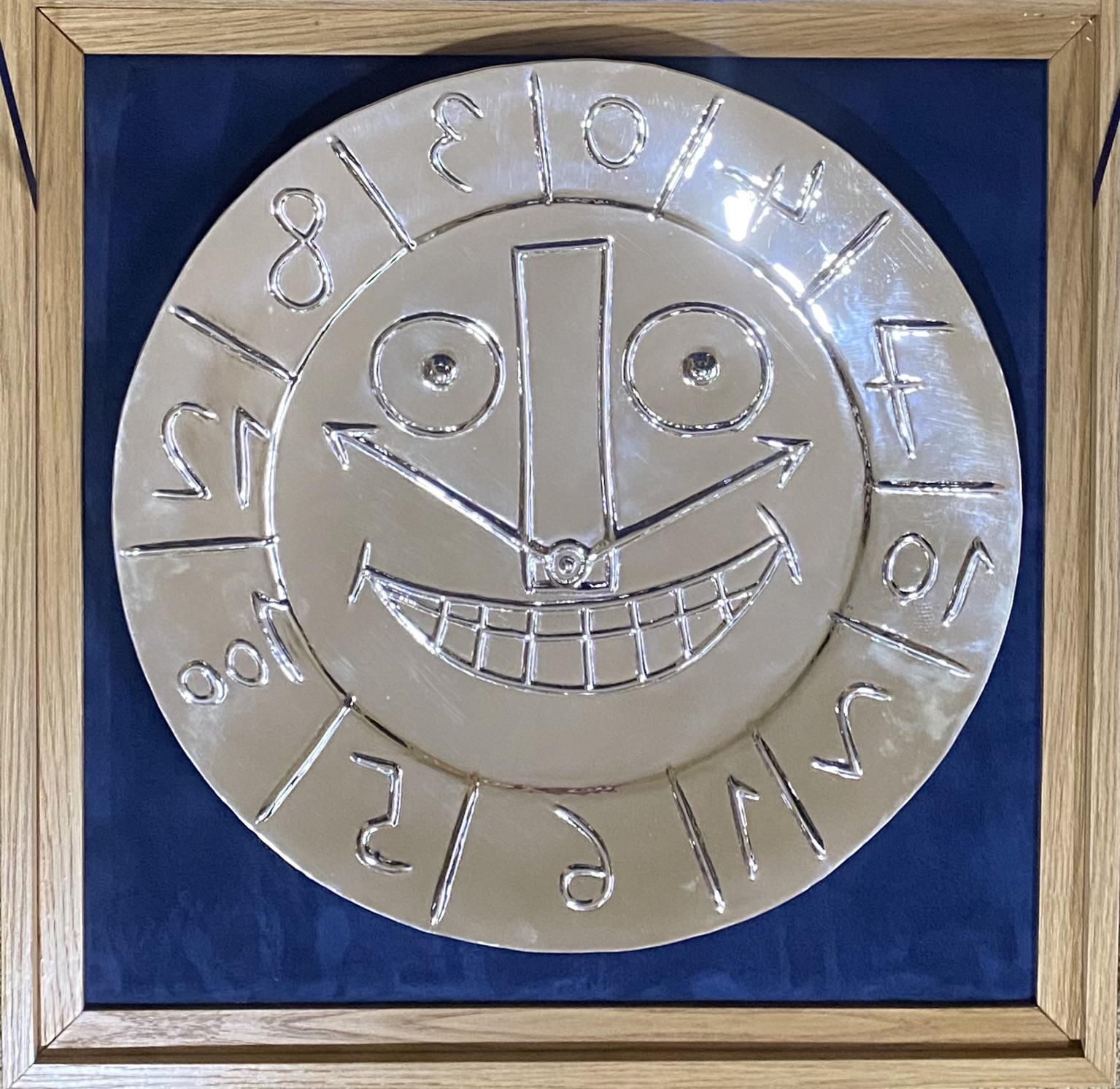
Visage en forme d’Horloge
Silver repoussé plate with wooden presentation box
42.5 cm (16 3/4 in.) diameter
Conceived in 1956
and executed in silver by François and Pierre Hugo in a numbered edition of 20
plus two exemplaires d’artiste, two exemplaires d’auteur.
Stamped with the artist’s signature and numbered ‘Picasso 6/20’ and stamped with the silversmith’s mark, the French assay mark for silver and numbered ‘1425/4671’ (on the reverse)
• The authenticity of this work has been confirmed by Ateliers Hugo.
• Provenance
– Atelier François & Pierre Hugo, France.
– Private collection, Europe
– Bonhams London, “Picassomania”, 18 May 2022, lot 30.
• Literature
– G. Bloch, Pablo Picasso: Catalogue de l’oeuvre gravé céramique, 1949-1971, Vol. III, Bern, 1972, no. 94 (white earthenware version illustrated p. 80).
– D. Cooper, Picasso, 19 plats en argent par François et Pierre Hugo, Paris, 1977 (another version illustrated).
– A. Ramié, Picasso, Catalogue of the edited ceramic works, 1947-1971, Madoura, 1988, no. 326 (white earthenware version illustrated p. 166).
– P. Hugo & C. Siaud, Bijoux d’artistes: Hommage à François Hugo, Aix-en-Provence, 2001, no. 2 (another version illustrated p. 170).
Verso:

Pablo Picasso’s silver plates are a rare, highly coveted series of 24 silver platters conceived in 1956. A complete set of all 24 silver plates has fetched GBP 1,467,000 (USD 2,000,000) at Sotheby’s in 2021.
The silver plates were born from a brilliant collaboration between Picasso and the renowned French silversmith François Hugo (the great-grandson of writer Victor Hugo). In May 1956, while reviewing his ceramic works at the Madoura studio in Vallauris alongside art historian Douglas Cooper, Picasso remarked that his clay plates would look magnificent if rendered in silver—reminiscent of the grand ceremonial basins of the 16th and 17th centuries. Cooper introduced him to François Hugo, and the project began.
The plates were meticulously crafted using the repoussé and chasing techniques:
• Picasso provided unglazed ceramic plates (biscuits) to serve as the master models.
• Sheets of 950 sterling silver were heated and hammered from the reverse side into a wax matrix to capture every relief, indent, and texture.
• Every plate is stamped on the back with Picasso’s signature, the Hugo goldsmith mark, French assay marks, and an edition number.
Initially, Picasso treated these silver objects as a private collection, keeping them for himself and close friends. He only authorized Hugo to sell them commercially starting in 1967. Each of the 24 designs was strictly limited to an edition of 20 numbered copies, plus 2 artist’s proofs (A.P.) and 2 non-commercial copies (H.C.).