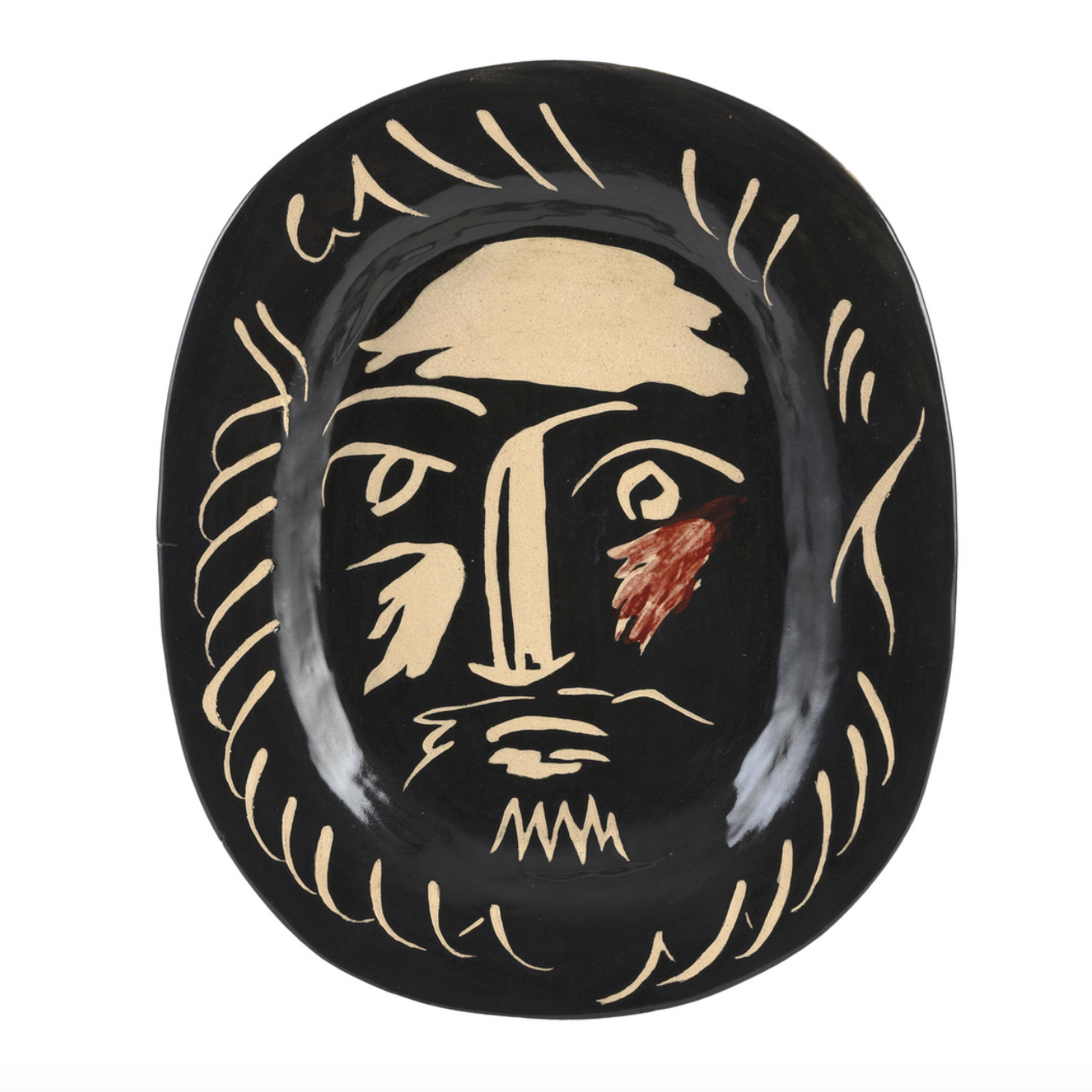
Pablo PICASSO (1881-1973)
Visage d’Homme (A.R. 203)
1953
White earthenware ceramic plate painted in engobes (black, white, red)
and knife engraved under glaze.
15 2/5 x 12 3/5 in. (39 x 32 cm.)
Stamped “Macoura Plein Feu” and “Edition Picasso” (verso)
Conceived on 14 October 1953 and executed in an edition of 50.
Literature:
– Alain RAMIÉ, “Picasso, Catalogue of the edited ceramic works 1947-1971”, another version ill. p.110, no. 203
Where Visage de Femme softens Picasso’s line into curves, Visage d’Homme shows the other register of his ceramic portraiture: stark, angular, almost totemic. Conceived on 14 October 1953, this white earthenware plate strips a man’s face down to its essentials — bold knife-engraved contours filled with black, white, and red engobes beneath the glaze, giving the features a woodcut-like intensity rarely seen elsewhere in his ceramic output.
What sets this piece apart, even among Picasso’s ceramics, is its rarity: the edition numbers just 50 examples, a fraction of the print runs typical of his Madoura work, which often ran into the hundreds. For a collector, that scarcity matters — this is one of the more exclusive forms in which Picasso’s ceramic imagery circulates. The plate carries the “Madoura Plein Feu” and “Edition Picasso” stamps to the verso and is formally catalogued in Alain Ramié’s reference work on Picasso’s ceramics, illustrated on page 110, no. 203.
The piece delivers the qualities that define great Picasso ceramics — an unmistakable, gestural hand; a bold and graphic image that reads as sculpture as much as decoration; and full scholarly documentation — combined with an edition size small enough to appeal to collectors specifically drawn to rarity within an already limited category of Picasso’s output.