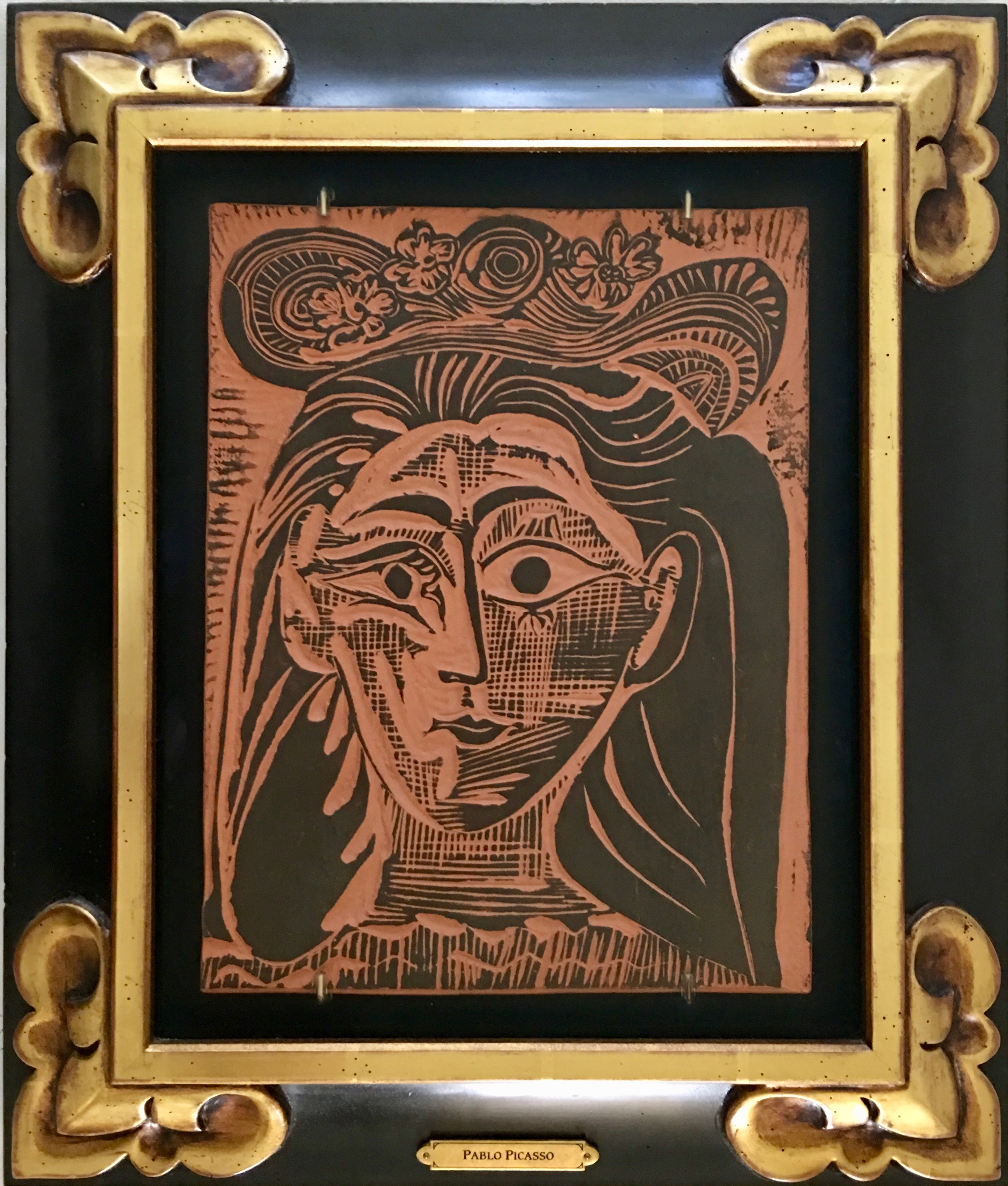
Pablo PICASSO (1881 – 1973)
Woman with Flowery Hat / Femme au chapeau fleuri (A. R. 521)
1964
Terracotta plaque with black glaze.
13 x 10 in / 33 x 25.5 cm
Stamped MADOURA PLEIN FEU/ EMPREINTE ORIGINALE DE PICASSO and numbered 62/100 on the reverse.
Conceived in 1964 and executed in a numbered edition of 100
Literature:
-
- Alain RAMIE, Picasso, Catalogue of the edited ceramic works 1947-1971, another version ill. p.260, n.521
- Georges RAMIE, Picasso’s Ceramics, another version ill. p. 254, n.635.
Exhibitions:
- The Metropolitan Museum of Art, New York: “Picasso in The Metropolitan Museum of Art,” April 27–August 1, 2010, no. C3. [another number exhibited].
- The Metropolitan Museum of Art, New York: “Picasso Linoleum Cuts: The Mr. and Mrs. Charles Kramer Collection in the Metropolitan Museum of Art,” March 7–May 12, 1985, unnumbered cat. (pl. 148). [another number exhibited]
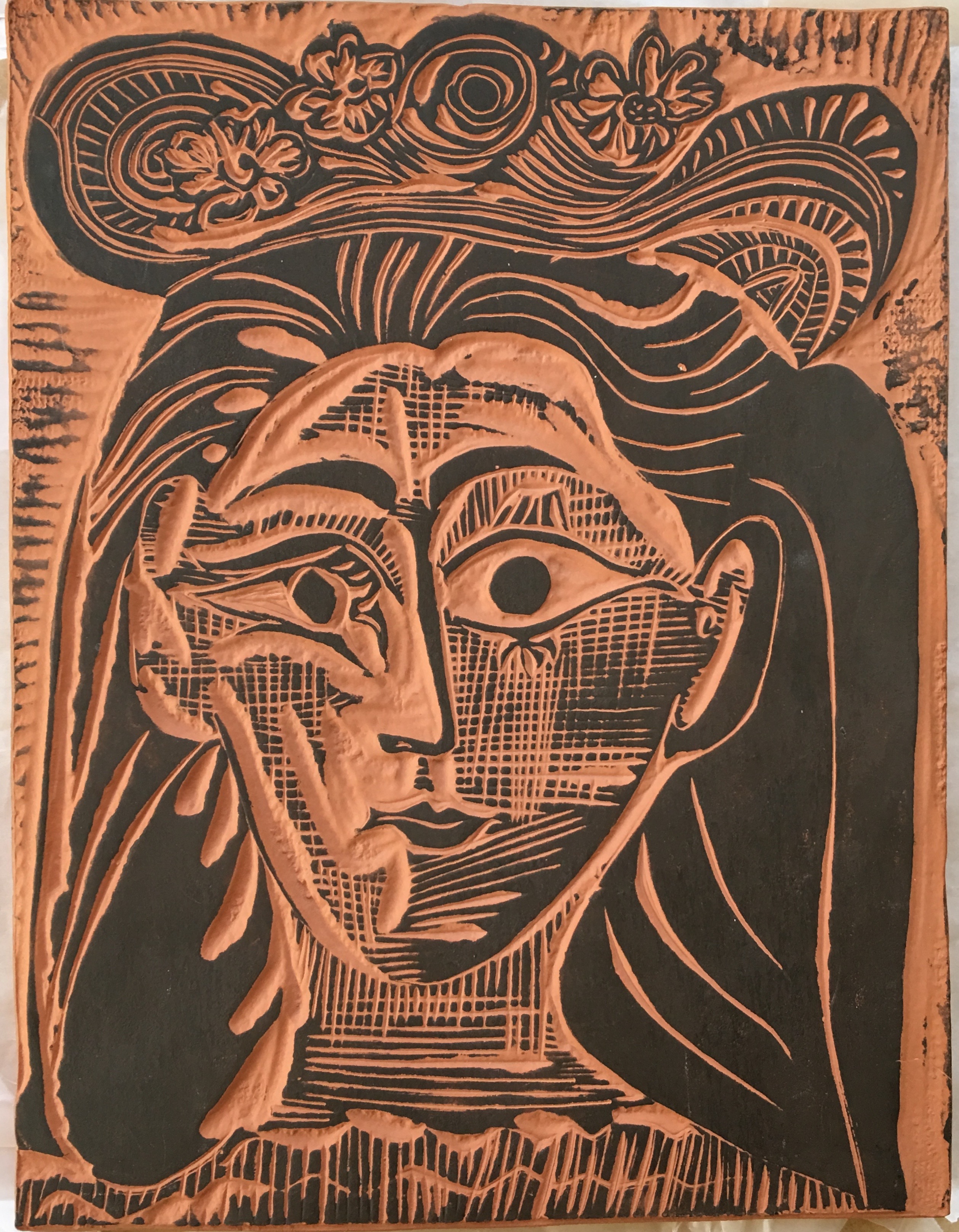

This plaque holds a distinction few Picasso ceramics can claim: it is a portrait of Jacqueline Roque, the woman who was both his last wife and his most enduring artistic obsession. Picasso met her in 1952 at Madoura, married her in 1961, and went on to portray her more than 400 times — more than any other muse in his career. Here, her strong, dark features are carved into terracotta with the vigorous, graphic energy of a linocut, translated from an actual linoleum block Picasso created with printmaker Hidalgo Arnéra and then cast into ceramic at Madoura in 1964. The result fuses two mediums Picasso mastered separately — printmaking and ceramics — into a single object. The superb texture of this work, with the fine, vigorous carving and the linocut style of mark-making that emphasize the strong dark features of Picasso’s muse, is strongly reminiscent of the artist’s cubist roots.
This work belongs to a series of just seven such plaques, five of which depict Jacqueline, making it a rare intersection of technique, subject, and biography within Picasso’s ceramic output. It is numbered 62/100, stamped “Madoura Plein Feu / Empreinte Originale de Picasso,” and formally published in both standard references on the artist’s ceramics — Alain Ramié’s catalogue and Georges Ramié’s Picasso’s Ceramics. Its exhibition record is exceptional for a work in this category since another exemplary of the same plaque was shown twice at the Metropolitan Museum of Art, in “Picasso Linoleum Cuts” (1985) and “Picasso in The Metropolitan Museum of Art” (2010).
For a collector, this is a rare convergence of factors: a documented portrait of Picasso’s great late-life muse, an innovative technique unique to a small series, and a museum exhibition history that few Picasso ceramics anywhere can match.