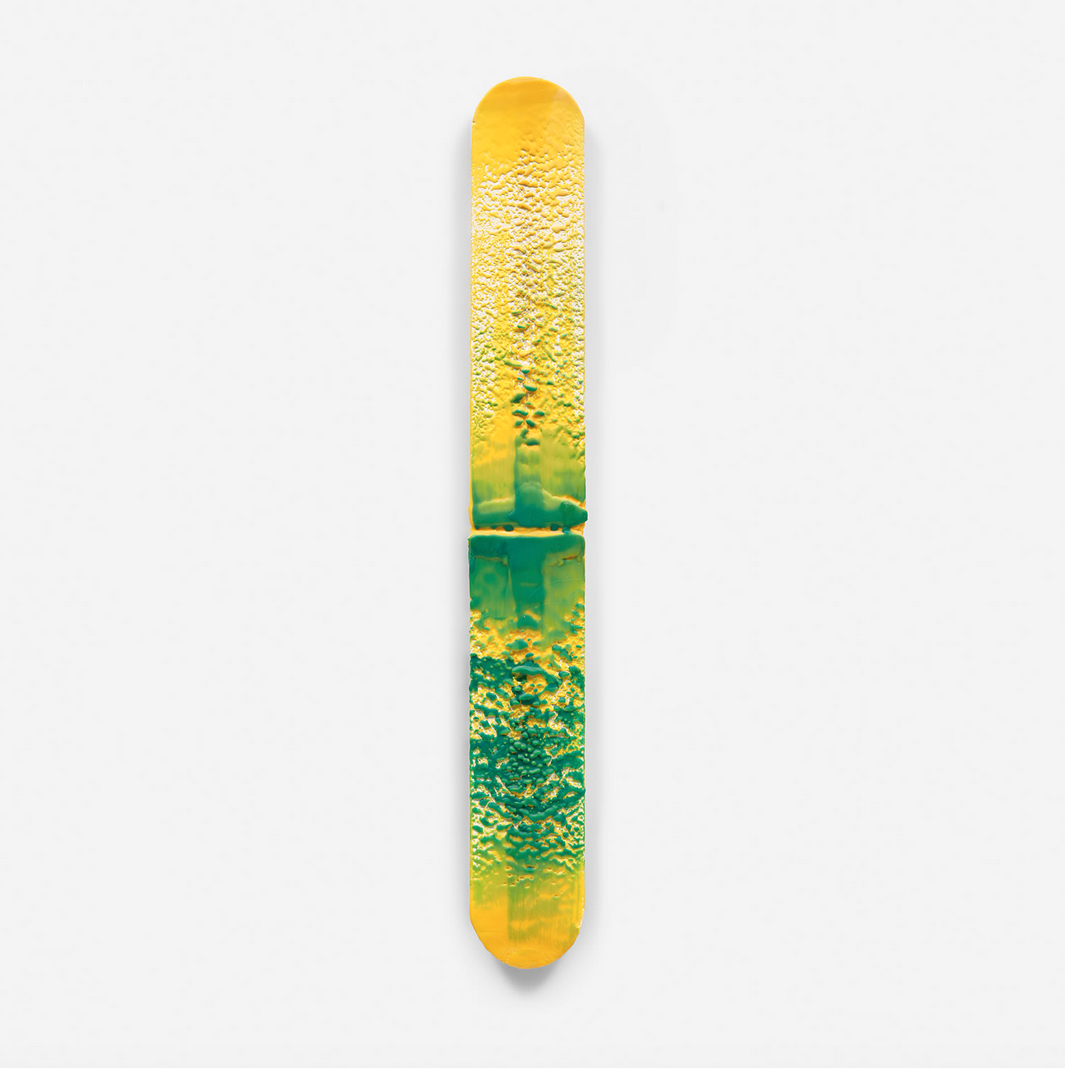
Lynda Benglis (b. 1941)
Devil’s Bath
Purified pigmented beeswax and dammar resin crystals and pigment on composite board.
1993
Signed, titled and dated “L Benglis ’93 “Devil’s Bath”” on the reverse.
38 3/8 x 5 x 1 1/8 in. (97.5 x 12.7 x 2.9 cm.)
Executed in 1993 in New Zealand, when the artist was participating in the Auckland
Artist-in-Residence programme, and inspired by the Waiotapu geothermal area.
Provenance:
– Margo Leavin Gallery, Los Angeles.
– Private collection, acquired from the above in 2007.
Exhibition:
– Auckland City Art Gallery, Lynda Benglis: From the Furnace, October 15–November 25, 1993, no. 2, pp. 28, 40 (illustrated, p. 28).
– Los Angeles, Margo Leavin Gallery, Installations, July 16–August 20, 1994.
Literature:
– Lynda Benglis: From the Furnace, exhibition catalogue from the Auckland City Art Gallery, 1993, illustrated in color p. 28 (cat. 2).
“Devil’s Bath” is a notable artwork created in 1993 by the renowned American artist Lynda Benglis. This piece exemplifies her ongoing engagement with organic forms and physical processes, pushing the boundaries of post-minimalist sculpture and painting.
The work was executed in 1993 in New Zealand (when the artist was participating in the Auckland Artist-in-Residence programme) and inspired by the Waiotapu geothermal area, known for its striking, naturally colorful hot springs including a neon-green water crater called the Devil’s Bath. The bubbling volcanic landscape and mineral crusts reignited Benglis’s passion for the encaustics she had pioneered in the 1960s and 1970s.
The artist’s “wax paintings” (or encaustic works) are among her most significant contributions to the Post-Minimalist movement of the late 1960s and 1970s. Beginning in 1966 with her seminal piece “1st Wax Work” (National Gallery of Art, Washington, D.C.), this series radically blurred the boundaries between flat, two-dimensional painting and three-dimensional sculpture.
To create these objects, Benglis applied successive layers of a heated mixture of purified beeswax, damar resin, and pigments onto long, narrow lozenge-shaped wooden panels or masonite supports. The physical dimensions of the wooden structures were directly determined by the length of her own arm and the width of her brushstroke. Once the wax solidified, Benglis manipulated the surface using a blowtorch. Fusing the layers created a marbled effect, leaving behind a cratered, fractured, and highly tactile topography.
These paintings functioned as a double-edged critique of the dominant art historical narratives of her era: abstract expressionism and minimalism.
By liquefying and freezing her medium, Benglis reimagined Jackson Pollock’s “dripping” technique. The brushstroke was no longer just a flat mark on canvas; it became what she called a “frozen gesture” with physical weight and mass.
In response to the cold, rigid, and industrial geometric forms of her male minimalist contemporaries, Benglis offered organic, flesh-like, and visceral forms. This early exploration of fluid materials served as a direct stepping stone to her iconic, colorful poured latex and polyurethane foam floor installations.
Today, major pieces from this series, such as “Embryo II”, are preserved in prominent public collections, including the Museum of Modern Art (MoMA), the Metropolitan Museum of Art (Met) in New York and the National Gallery of Art in Washington, D.C.