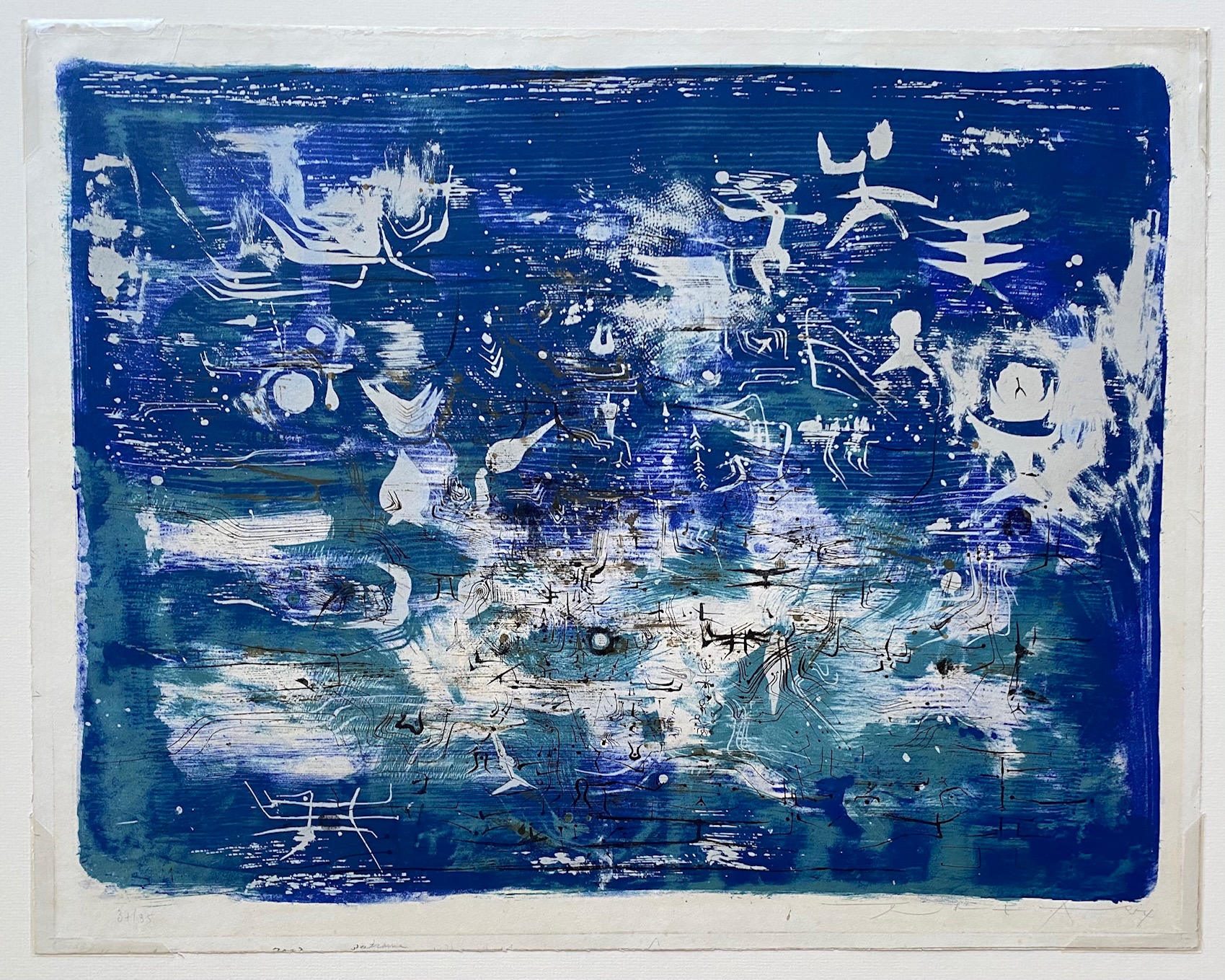
Zao Wou-ki (1920-2013)
Jardin la Nuit / Garden at Night
Lithograph printed in 5 colours on Rives paper.
1954
Image: 44 x 57 cm. (17 3/8 x 22 3/8 in.)
Sheet: 50 x 65,5 cm. (19 7/10 x 25 4/5 in.)
Edition of 95 on Rives paper + 21 AP + 3 proofs on Japan paper
Signed and dated lower right, numbered lower left 37/95.
Printed by E. and J. Desjobert, Paris.
Published by Klipstein & Co, Berne.
• Literature:
– Nesto Jacometti, ed., Catalogue raisonné de l’œuvre gravée et lithographiée de Zao Wou-Ki, 1949 – 1954, Edition Gutekunst & Klipstein, Bern, 1955, plate 60, p. 72
– Yves Rivière, ed., Zao Wou-Ki: Les estampes 1937 – 1974, Arts et Métiers Graphiques, Paris, 1975, plate 90, p. 55
– Jørgen Ågerup, ed., Zao Wou-ki: The Graphic Work, A Catalogue Raisonné 1937-1995, Edition Heede & Moestrup, Copenhagen, 1995, plate 87, p. 61
– Céline Chicha, Marie Minssieux-Chamonard, Hélène Trespeuch, ed., Zao Wou-Ki: estampes et livres illustrés, Bibliothèque nationale de France, Paris, 2008, plate 17, p. 64
• Exhibition: Paris, Bibliothèque nationale de France, Zao Wou-Ki. Estampes et livres illustrés, 3 June – 24 August 2008 (another edition)
A rare opportunity to acquire a work from the exact turning point of Zao Wou-Ki’s career. 1954 is the year Zao broke decisively from figurative, landscape-based painting and turned inward to his own Chinese heritage — drawing on ancient oracle bone script and bronze vessel inscriptions to invent the calligraphic abstract language that would define his mature style and, eventually, make him one of the most sought-after painters at international auction. Works from this precise threshold moment are exceptionally scarce on the market; most surviving examples from Zao’s decisive shift into abstraction are held in institutional collections.
Printed in five colours by the celebrated Parisian atelier E. and J. Desjobert and published by Klipstein & Co. of Berne, this lithograph carries the full weight of scholarly validation: it is catalogued in no fewer than four separate catalogues raisonnés (Jacometti, Rivière, Ågerup, and Chicha et al.), and was exhibited at the Bibliothèque nationale de France in 2008 — the kind of institutional and academic pedigree that gives collectors real confidence in long-term value.
At a compact, gallery-friendly scale, Jardin la Nuit offers collectors an accessible entry into a defining moment of twentieth-century abstraction — the visual birth of the language that carried Zao from Paris obscurity to the top tier of postwar art.